

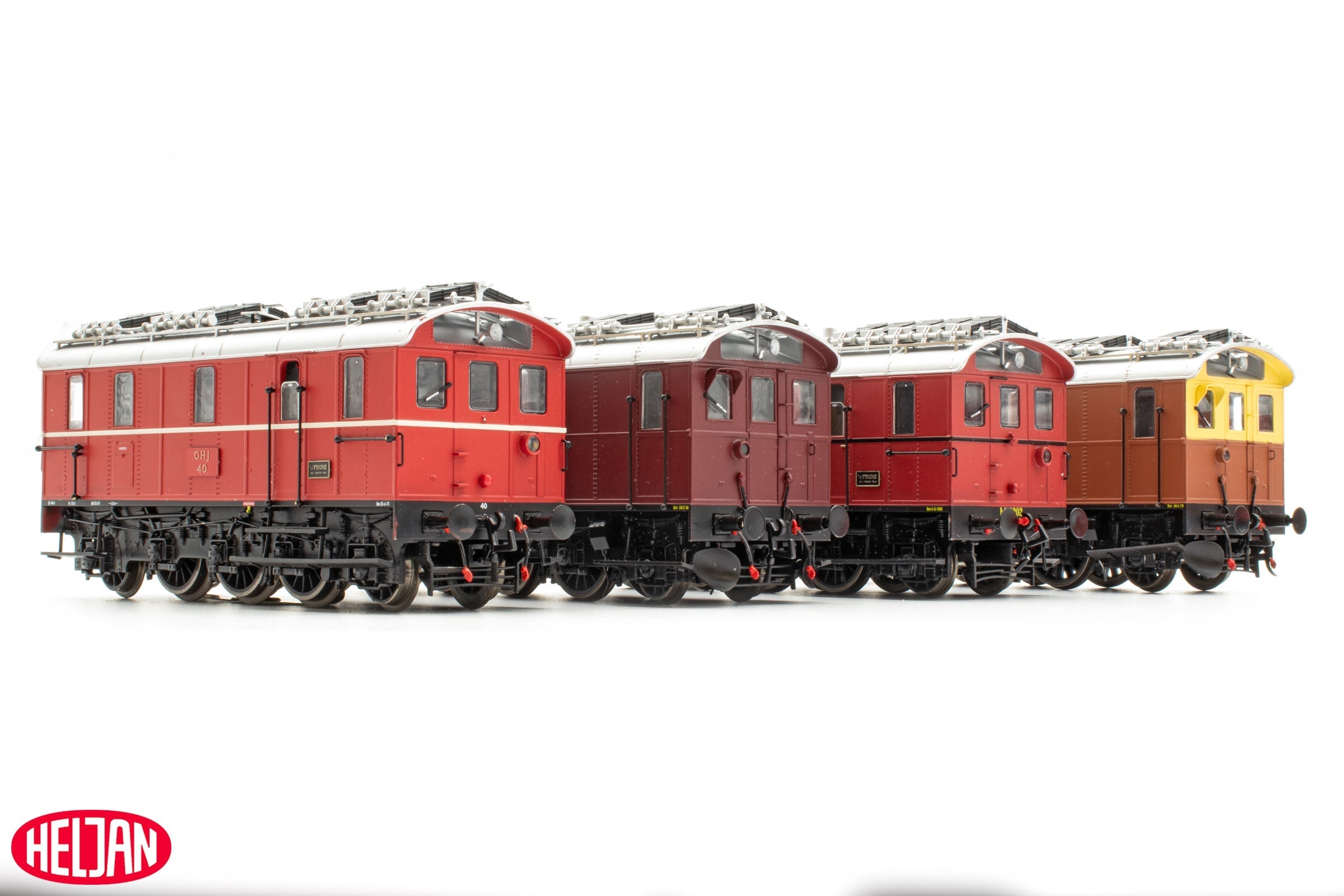
It's been a very busy period for us here at Heljan as we settle into our new life being part of the Accurascale group of brands. We are fully aware that we have been very quiet when it comes to our home market of Denmark, and our HO outline models.
We are very sorry for this, but we can assure you that we have been working very hard to organise our future, making our long term, ambitious plans, and working on previously announced and unannounced models in HO, starting with the FRICHS Firkant!
Now we are very excited to bring you an update on this all-new HO locomotive, and show you the decorated samples for the very first time.
But, before we explore the samples and give you a full update, let's look at the history of the real locomotives, which will explain why we are so excited about this new model.

The history of the development of FRICHS “Square” diesel locomotives
In 1924, the locomotive manufacturer FRICHS entered into a collaboration with the rolling stock manufacturer Scandia. In 1926, Scandia built the first diesel-electric locomotive with a teak wood body and a diesel engine supplied by FRICHS. This partnership resulted in the delivery, up to 1932 and following the same concept, of 15 diesel locomotives and 14 railcars: 9 locomotives and 8 railcars for private railways, as well as 6 MR railcars and 6 MT locomotives for the Danish State Railways (DSB). The latter were DSB’s first diesel-electric locomotives. In 1932–33, a further 4 sheet-metal-clad MQ railcars were delivered to DSB and 2 to private railways.

The first diesel locomotive built solely by FRICHS was class MV, delivered to DSB in 1929. The body rested on plate frames as known from steam locomotives, and the body itself was constructed of aluminium. The MV class was equipped with a luggage compartment, steam heating boiler, vacuum brake system, and compressed air brakes. The generator and traction motors were supplied by TITAN. The 420 hp diesel engine featured, as something entirely new, pressure atomization and two fixed engine speeds.
Maximum speed was 80 km/h. In 1947, the engine was replaced with a larger 500 hp unit, and the MV was withdrawn from service in 1955 after 26 years of operation. In many respects, the MV served as a model for FRICHS’ subsequent production of diesel locomotives using similar technology up until 1938.

In June 1930, FRICHS received an order for 7 locomotives and 6 railcars for the Royal State Railways of Siam. However, FRICHS considered the order too small and therefore submitted an offer to DSB for two diesel locomotives: one 450 hp unit similar to the two MV locomotives already delivered, and another shorter version based on the Siam locomotives, featuring four driving axles and two bogies.
The contract with DSB for two locomotives, class MX, with four driving axles and a power output of 2 × 450 hp at 600 rpm, was signed in the autumn of 1930. Like the MV, the body was mounted on plate frames, but was constructed of steel plate.

The MX locomotives were equipped with an automatic steam heating boiler as well as vacuum and compressed air brakes. They entered service in March 1932. The operational target was a mileage of 10,000 km per month per locomotive. However, faults in the heating boiler and leaks in the engines led to considerable maintenance downtime. During the summer of 1933, each locomotive nevertheless achieved approximately 8,000 km per month.
The basis for HELJAN’s model of five FRICHS locomotives with 410 hp engines

In 1934, Lollandsbanen (LJ) received the first two five-axle locomotives, M 8 and M 9. These locomotives largely resembled those used on the Fjerritslev–Frederikshavn Railway, but were longer and featured an automatic steam heating boiler instead of a luggage compartment. They were painted in a beige-yellow colour across the middle of the body and quickly earned the nickname “the Canaries”. The locomotives were delivered with vacuum brakes and geared for 85 km/h. Unlike other “square” locomotives, which used 65V batteries, M 8 and M 9 were supplied with 110V batteries due to the railway’s charging facilities.
In 1952, the locomotives were fitted with compressed air brakes and buffer cylinders, and the heating boiler was removed. Instead, modified baggage cars with steam boilers were used in passenger service. At the same time, the right-hand cab door was sealed to reduce draught. During a late 1960s overhaul, M 8 was repainted maroon, while M 9 retained its original livery.

In 1936, the Aalborg–Hvalpsund (AHB) and Aalborg–Hadsund (AHJ) railways each acquired a five-axle locomotive, AHB ML 3202 and AHJ ML 5203 respectively. Unlike earlier models, these locomotives had only one door on each side, leading directly into the engine room. All locomotives for the Aalborg lines were built without front doors and delivered with vacuum brakes and oil-lubricated Peyinghaus plain bearings. Maximum speed was 80 km/h.
During the war, AHB ML 3202 was converted to run on natural gas. When this system was removed again in 1945 and diesel operation resumed, ML 3202 was fitted with two additional roof-mounted radiators.

In 1952, the locomotives were converted to compressed air brakes. The battery disconnect switch was relocated to a recess on the right side, and the diesel filling point was moved behind a hatch on the left side. Snowploughs were fitted beneath cab 1, extending beyond the profile but shaped with cut-outs to clear platforms and trackside obstacles. In the 1960s, rubber-framed front windows were installed and the lower headlamp was moved to the left side.
Everyday operation of the five-axle FRICHS locomotives on private railways

The locomotives proved to be extremely reliable. Engine failures did occur occasionally, often due to the quality of materials available in the 1930s.
They were primarily used for mixed daily trains carrying parcel and wagonload freight on private railways. They also hauled long passenger trains, school excursion trains, heavy freight trains with fuel for towns, and fertiliser for agriculture.
On Lollandsbanen, M 8 and M 9 operated through passenger services between Nykøbing Falster and Nakskov. After the introduction of the 750 hp FRICHS “Marcipanbrød” locomotives M 31 and M 32 in 1952, the “square” locomotives were mainly used for smaller passenger and freight trains. In the event of failures of the railway’s MaK locomotive M 33 (delivered in 1958), the “square” locomotives were also used in double-heading for heavy freight trains.

On the Aalborg private railways, the “square” locomotives mainly hauled the larger passenger trains until the introduction of railbuses and FRICHS “Marcipanbrød” units around 1948–53. Steam locomotives were subsequently phased out, and the “squares” increasingly handled freight traffic, including peat transport. In April and May 1953 alone, this resulted in 44 special trains carrying approximately 1,000 wagons from Lille Vildmose (Gudumholm) to the cement factory Rørdal in Aalborg.
FRICHS locomotives from the 1930s achieved service lives of 40 to 50 years, which is remarkable considering they were built without long-term production experience and used technology that was new and largely untested.
The introduction of FRICHS locomotives significantly reduced energy and maintenance costs, contributing to the near-complete phasing out of steam operation on private railways. Together with Scandia’s railbuses, FRICHS locomotives played a major role in ensuring that many private railways survived into the 1960s. Some of the lines that operated FRICHS locomotives still exist today, although under different names.
The Model

Consisting of mainly diecast construction, our HO scale model of this mythical Danish diesel icon has the pulling power to exceed what was expected of the real locomotives. The models capture the elegant lines of these early diesel pioneer locomotives, and feature detail differences which were evident on the real locomotives across their operational careers.
We are currently examining the fit and finish of these locomotives, and are recommending improvements to be made on the models by the factory. This consists of better protection for the chassis and foot step areas, as well as better care taken when fitting the glazing, and some decoration corrections too.

We wish to take extra time and care to get this locomotive to be a top quality model, and while development began before we became part of the Accurascale family, we are determined to show how the quality of these important locomotives will match any other locomotive in your collection, and offer a preview into our future models.
Part of that future revolution is buying direct from our website, where you can sign up and get 10% off your first order, enjoy free postage and packaging and also 3% cashback off a future order as part of our customer loyalty programme.
You can place your pre-order today via your local retailer in 2 rail DC or 3 rail AC, or direct via the link below. We expect production of the models to be complete by the end of this year.


