

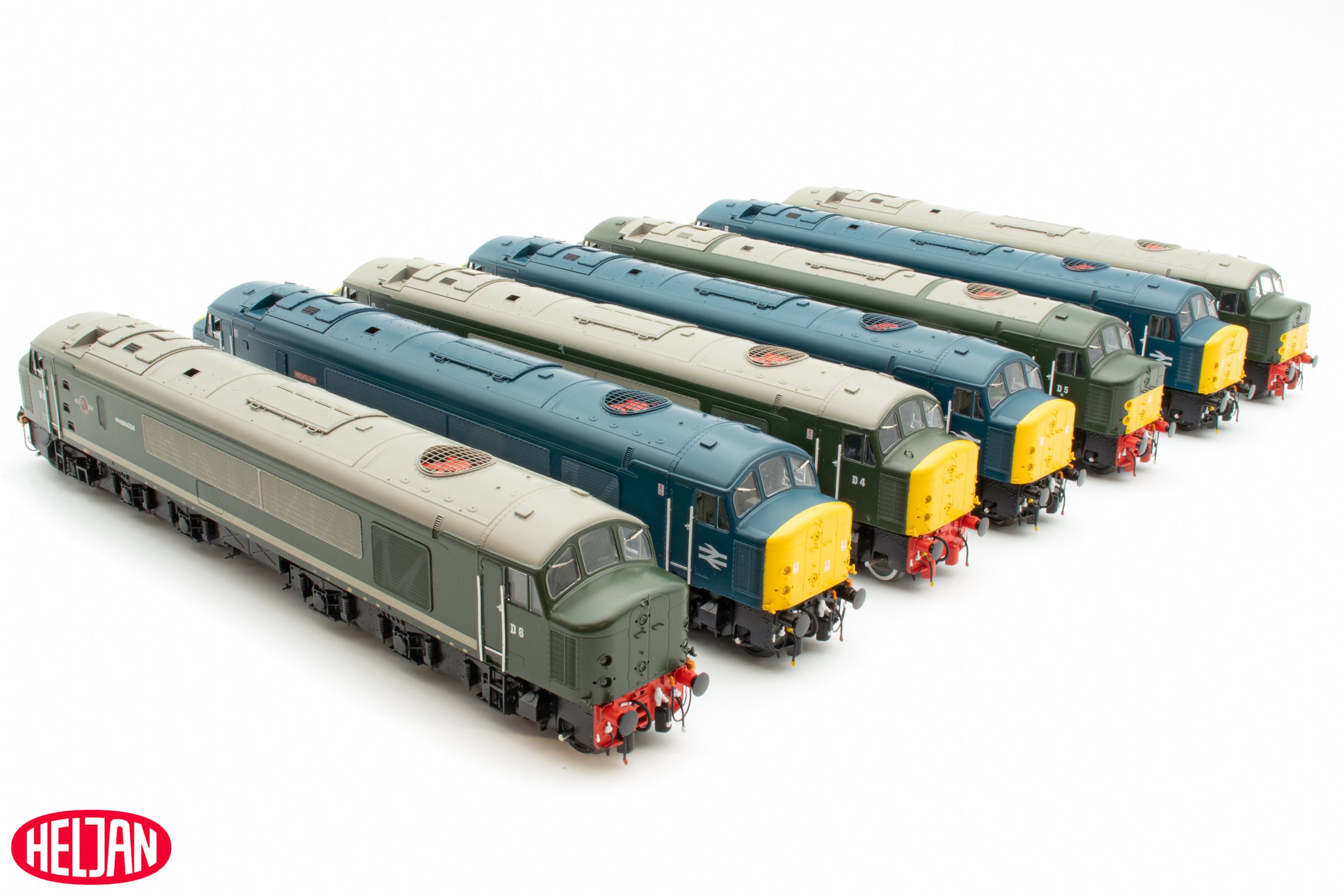
For fans of British Rail's iconic "Peak" locomotives, the wait is almost over. Our forthcoming OO gauge Class 44 promises to be the most historically accurate and feature-rich ready-to-run model ever produced of Britain's pioneering Sulzer Type 4s.
This all-new tooling captures the subtle differences that developed throughout the ten-member Class 44 fleet during their two decades of service, giving modellers unprecedented prototype fidelity when it comes to this lovable beasts.
The Original Peaks

The story of the Class 44 begins with British Railways' ambitious 1955 Modernisation Plan. As steam traction was phased out, BR launched the famous Pilot Scheme, commissioning a range of diesel locomotive designs to determine the most effective types for future production.
Constructed at Derby Works, the ten locomotives numbered D1-D10 became Britain's first heavyweight Sulzer Type 4 diesel-electrics. Powered by a 2,300hp Sulzer engine and weighing over 130 tons, they were designed for both express passenger and heavy freight duties.

Initially allocated to Camden depot, the new locomotives replaced Stanier Pacific steam locomotives on prestigious West Coast Main Line services between London Euston and the North West, while also appearing on Midland Main Line expresses.
However, despite their impressive appearance and advanced engineering, the Class 44s quickly revealed several shortcomings. Bogie fatigue cracks, traction motor issues, unreliable steam heating equipment, battery failures and vacuum exhauster problems all combined to limit their effectiveness. They also proved underpowered for sustained high-speed express work.

As newer and more capable Class 45 and Class 46 "Peaks" entered service, the original ten locomotives found a new role. By early 1962 virtually the entire class had transferred to Toton depot near Nottingham, where they spent the remainder of their careers hauling heavy coal, mineral and general freight trains throughout the Midlands and beyond.
Over time the locomotives lost their steam heating boilers, water tanks and multiple working equipment, becoming dedicated freight locomotives until withdrawals began in 1976. By the end of 1980 the class had disappeared from BR service, although thankfully two examples—44004 and 44008—were preserved and remain operational today.
A Model That Celebrates Every Stage of the Class

One of the standout features of our all-new release is the attention paid to the changing appearance of individual locomotives throughout their careers.
Rather than producing a generic Class 44, each version accurately reflects the prototype during a specific period, incorporating the correct combination of:
- Sandboxes
- Boiler water tanks
- Multiple working equipment
- Boiler steps
- Bonnet-top handrails
- Warning panel styles
- Headcodes
- Lighting arrangements
This means each locomotive represents a genuine snapshot in time rather than a compromise.
Seven Authentic Liveries
The launch range covers virtually the entire operational history of the class.
4400 – D6 Whernside

Presented in pristine BR Green "as delivered" condition, D6 features multiple working equipment and the original four sandboxes per bogie. Delivered to Camden in November 1959, it worked prestigious passenger services before moving to freight work at Toton. Notably, it became the final Class 44 to retain BR Green, only receiving blue in 1973.
4401 – D9 Snowdon

One of the highlights of the range.
D9 was one of only two Class 44s fitted with experimental slotted bodyside grilles, making it visually distinct from every other member of the class. We depict the locomotive in early-1960s BR Green with small yellow warning panels before its accident-damaged No.1 end was rebuilt.
4402 – D1 Scafell Pike

The first-built Class 44 appears in early-1970s BR Blue before receiving its TOPS number. The model correctly omits the boiler water tanks and multiple working equipment while carrying only two sandboxes per bogie.
4403 – D5 Cross Fell

Representing the attractive but often-overlooked "Economy Green" livery, D5 captures the appearance of many Peaks during the late 1960s before BR Blue became universal.
4404 – 44010

The second locomotive fitted with experimental slotted bodyside grilles is shown in its final BR Blue condition after losing its Tryfan nameplates.
4405 – D4 / 44004 Great Gable

Perhaps the star attraction of the range.
During 1980, BR repainted 44004 into BR Green with full yellow ends and restored its original D4 identity to celebrate the final days of the class. The locomotive instantly became one of Britain's most photographed diesel locomotives.
We are the first manufacturer to produce an accurate ready-to-run model of this unique locomotive complete with its distinctive bonnet-top handrails.
4406 – 44002 Helvellyn

Representing the locomotive famous for high-speed testing, this model depicts the locomotive after TOPS renumbering in BR Blue. D2 was unique in being fitted with an uprated 2,500hp Sulzer engine when new and famously reached speeds approaching 110mph during West Coast Main Line testing.
Standout Features
Beyond the historical accuracy, we have also significantly raised the specification.
Among the headline features are:
- First-ever RTR models of D9 and D10 with experimental slotted bodyside grilles.
- First accurate RTR model of D4/44004 with the correct bonnet-top handrails.
- Correct early or late sandbox arrangements depending on prototype.
- Optional or omitted boiler water tanks according to era.
- Optional multiple working cables and steam heat connections on early locomotives.
- Correct open or plated boiler steps.
- Full set of headcode discs included.
- Etched metal nameplates supplied with every model—a Heljan first.
- Factory-fitted speakers across the entire range.
- ESU LokSound V5 decoder and professionally curated Class 44 sound project on DCC Sound versions.
- Independently switched marker, cab and tail lighting for DC users.
- Powerful five-pole motor with die-cast chassis for excellent hauling capability.
- Minimum operating radius of R2 (438mm).
Designed for the Detail Enthusiast

What really sets this release apart is our ability to tool variations that have been previously overlooked by other manufacturers
Whether it's:
- the slotted bodyside grilles unique to D9 and D10,
- the changing sandbox arrangements,
- subtle livery-era differences,
- or the removal of boiler equipment as the class evolved,
every version has been researched to represent a genuine locomotive at a specific moment in its career.
For Class 44 enthusiasts, these details matter—and we have listened.
Have We 'Peaked' Your Interest?
The original Peaks may have numbered only ten locomotives, but they played a pivotal role in the development of British Rail diesel traction. Their journey from flagship express locomotives to hard-working Midlands freight engines tells the story of BR's diesel transition itself.

Our new OO gauge Class 44 appears set to honour that history with what will be the most accurate ready-to-run representation of the class produced to date. From the pioneering D1 Scafell Pike to the much-loved preserved D4 Great Gable, every release captures a distinct chapter in the life of these remarkable locomotives.
With prototype-specific detailing, high-end electronics, factory-fitted sound provision and several genuine firsts for the ready-to-run market, this release looks set to become the definitive OO gauge Class 44 for collectors, operators and Peak enthusiasts alike.
With our Peaks now entering production, they remain on course for delivery in early Q1 2027, and with our reduced RRP structure for brand new models of just £149.99 for DC/DCC ready, and £249.98 for DCC sound fitted, they represent excellent value for money, as expected from Heljan!


